

Starting a medical practice is exciting… up until you realize how much work it actually is. The list keeps going: licensing, credentialing, staffing, billing systems, compliance. Most physicians know far more about caring for patients than about running a business, and that gap is exactly where new practices struggle. Once you understand how to open a medical practice, the process becomes easier to navigate and far less overwhelming.
Whether you’re opening a private practice or a multi-provider clinic, the right sequence saves you time, money, and serious headaches. Here is where to start.
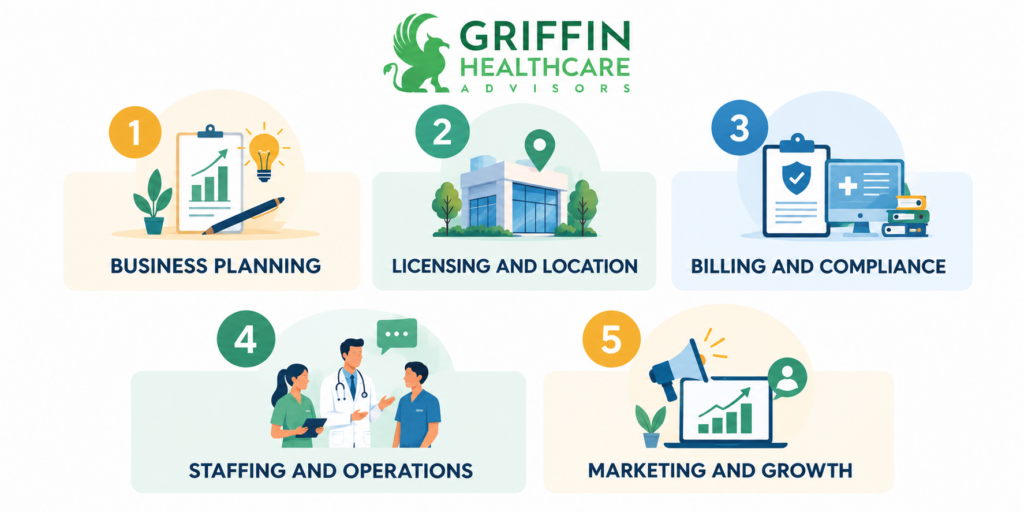
The right setup varies by model:
Whatever the model, financial planning comes first. Account for equipment, lease deposits, several months of operating costs before revenue arrives, and marketing.
Ready to speak with our experts? Pick a good time to talk today.
Before you can see your first patient, you will need:
These requirements for opening a medical practice need to be handled properly to avoid delays and compliance risk.
Most physicians run into the same pain points:
Knowing these challenges ahead of time makes the process efficient and seamless.

The two terms get used interchangeably, but the decision behind them is a real one. A private practice is usually built around one physician or a small partnership with a single specialty and a tight patient panel. A clinic typically means multiple providers, often across disciplines, with shared administrative infrastructure and longer operating hours.
That choice drives almost everything that follows. Knowing how to open a medical clinic means planning for a larger staffing model, more square footage, group credentialing with each payer, and a governance structure that defines how decisions get made among providers. A solo practice can be launched with a far lighter footprint, and most physicians underestimate how much administrative weight the clinic model adds.
The steps to open a healthcare clinic follow the same sequence as a private practice, with more moving parts at each stage. You still need a business plan, an entity, a location, licensure, credentialing, staffing, and a marketing plan. The difference is scale: each provider needs individual licensure and credentialing, the lease has to support the patient volume several providers will generate, and the staffing plan has to cover shared front-desk, billing, and clinical support across everyone.
Start credentialing before anything else. It is the longest lead time in the process and the most common reason a clinic opens behind schedule.
The cost to open a medical practice varies widely by specialty, market, and how much of the space and equipment you take on. Build-out, equipment, EMR, malpractice coverage, legal and licensing fees, initial staffing, and working capital to cover the first several months of operations before collections normalize are the main drivers.
The number most physicians miss is that last one. Insurance payments lag the first patient visits by weeks or months, so the practice has to fund payroll and rent before revenue arrives. We build that runway into every startup plan, because underestimating it is what turns a workable launch into a cash crisis in month four.

We actively help physicians open both private practices and multi-provider clinics across a range of specialties and across the nation. Whether you’re launching a solo practice or a larger clinic model, we handle the business side so you can take care of your patients. Our practice startup services cover:
You did the work and spent years becoming a great physician. Now build the practice you deserve: on time, on budget, and fully compliant.
You don’t have to go it alone. Let Griffin help by scheduling your consultation today!
A: Start with a business plan and financial model, then form the entity, secure licensure and DEA registration, obtain an NPI, begin payer credentialing, and line up malpractice coverage. Location, EMR selection, staffing, and marketing follow. The order matters more than most physicians expect, since credentialing and licensure run on timelines outside your control and should be started first.
A: The process is the same but the scale is larger. A clinic requires group credentialing with each payer, individual licensure for every provider, a space and lease sized for combined patient volume, a shared administrative and clinical support model, and a governance structure defining how the providers make decisions together. Plan for a longer runway and a heavier administrative load than a solo practice.
A: It depends on specialty, market, square footage, and how much equipment the specialty requires. The major categories are build-out, equipment, EMR, malpractice and business insurance, legal and licensing fees, initial staffing, and working capital. Budget deliberately for that last item, since collections typically lag your first patient visits by weeks or months while payroll and rent are already due.
A: Most practices take several months to a year from decision to first patient, and credentialing is usually the constraint. Payer credentialing can run months on its own and cannot be compressed once started, so it should begin well before the lease is signed. Building the timeline backward from your target opening date is the most reliable way to avoid an expensive delay.
A: At minimum you will need a state medical license for each provider, business registration in the state, an NPI number, DEA registration where controlled substances are involved, insurance credentialing with each payer you plan to accept, malpractice coverage, and HIPAA-compliant policies and systems. Specific requirements vary by state and specialty, and some municipalities add their own registrations.
A: A consultant is most valuable for the sequencing and the coordination, which is where solo launches typically go wrong. If you have the time to manage credentialing timelines, vendor selection, lease negotiation, and hiring alongside your current clinical schedule, you may not need one. If you do not, a consultant usually pays for itself by preventing the delays that cost you months of revenue.